
Last week we published A Kingdom of Priests: On Our Calling as Mediators. In preparing that piece to send, we searched through our Lightroom library for a hero image, and the search became something else entirely.
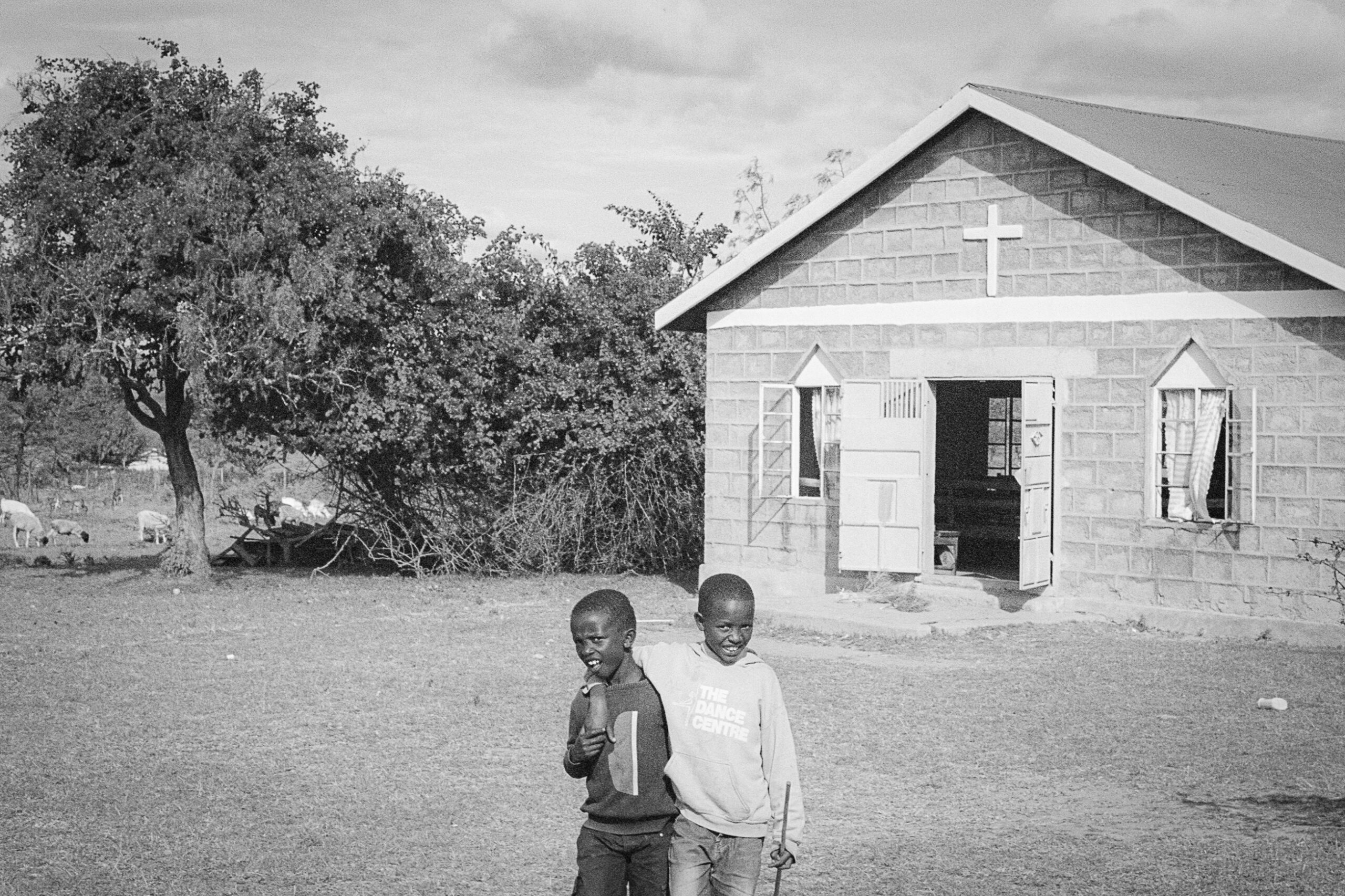
A church in Olderkesi surfaced first — cut stone block, a tin roof, goats grazing in the foreground. Then a one-room building in South America, where we once worshipped with a congregation whose entire sanctuary could fit inside a Stateside living room. Then a cathedral in Vietnam, preserved from the colonial era, vaulted and ornate. Then a fellowship in Israel. Then the church we helped construct in L’Moti, completed last August, standing now, still faithful.
A veritable parade of images. Stone and tin. Vaulted ceilings and dirt floors. Ancient masonry and raw timber. The building called church takes vastly different shapes and sizes than I had paused to consider.
And yet, before each photograph, I returned to the same conviction: none of these structures is actually the church.
This past weekend, I had the express honor of preaching in the church of a dear friend and former youth pastor in Knoxville, Tennessee. It is not the church I grew up attending, but it is the church where my parents worship now.
The weekend was special for many reasons. Among them was a planned reunion of the youth group I grew up in, shepherded through some very formable, and at times formidable, years of my life. Whether I would make it had been up in the air until the Marsabit trip was pushed up by a week, freeing my schedule to attend. Old friends returned for the reunion on Saturday. Faces I had not seen in years filled the room again. Contact long lost was restored in an afternoon.
On Sunday, I preached on spiritual drift and the story of Lot. At the close of the service, Barry — my friend, my former youth pastor, now my parents’ pastor — offered a benediction I have not stopped thinking about since:
“Remember, this building is not the church. You ARE the church.”
A simple line. Also a corrective I need to hear again and again.
We looked last week at our vocational calling into the priesthood — the truth that God’s people are called to mediate, to stand before Him on behalf of others and before others on behalf of Him. This past weekend, Barry’s benediction pressed two more truths into place: we are the church, we are the Body of Christ, and we were created for communion — with God, and with one another.
The pattern is old. Long before steeples or sanctuaries, the people of God were already learning what it meant to gather as one body.
After the exodus from Egypt, the LORD instructed Moses to receive contributions from the people for the construction of the tabernacle — the portable dwelling place of God among His redeemed. The people responded with striking eagerness.
And they came, both men and women, all who were of a willing heart, and brought brooches and earrings and signet rings and armlets, all sorts of gold objects, every man dedicating an offering of gold to the LORD… All the women who had a skillful heart spun with their hands… All this the people of Israel brought as a freewill offering to the LORD.
— Exodus 35:22, 25, 29 (ESV)
They did not bring these offerings merely to build something. They brought them because they were part of something. They were the redeemed of Egypt, carrying a shared trauma and a shared deliverance, having crossed the same sea, eaten the same manna, trembled before the same mountain. The tabernacle was never merely a construction project. It was the visible sign of an invisible communion — a people who belonged to the God of Abraham, Isaac, and Jacob, and who therefore belonged to one another.
This is the pattern we want to trace: the corporate body of God’s people, gathering and dispersing, again and again, across the whole of Scripture.
Solomon and the Temple. Centuries later, the tabernacle gave way to a fixed house — Solomon’s Temple in Jerusalem. At its dedication, the assembly gathered was vast:
Then Solomon assembled the elders of Israel and all the heads of the tribes, the leaders of the fathers’ houses of the people of Israel, before King Solomon in Jerusalem, to bring up the ark of the covenant of the LORD out of the city of David, which is Zion.
— 1 Kings 8:1 (ESV)
The building was grand. The gathering was the point. Israel assembled as one body before the LORD, and the glory of God filled the house so thickly that the priests could not stand to minister (1 Kings 8:10–11). Notice the proximity required: the elders did not send word from a distance. They came near, in person, until the glory of God pressed the room.
Ezra and the Return. After exile stripped Israel of temple, land, and identity, the returning remnant did not first rebuild walls. They rebuilt worship.
And when the seventh month came, and the people of Israel were in the towns, the people gathered as one man to Jerusalem.
— Ezra 3:1 (ESV)
As one man. Not scattered individuals with a shared address, but a single body, reconstituted around the altar before a single stone of the Temple was relaid. Exile had scattered them across towns and provinces; worship required them to close that distance — to travel toward one another before a single stone was set.
The same gathered posture reappears once the walls themselves stand again. The assembly returns to that identical formation — as one man — this time not to lay an altar, but to hear the Law read aloud for the first time since the exile began:
And all the people gathered as one man into the square before the Water Gate. And they told Ezra the scribe to bring the Book of the Law of Moses that the LORD had commanded Israel. So Ezra the priest brought the Law before the assembly, both men and women and all who could understand what they heard, on the first day of the seventh month. And he read from it facing the square before the Water Gate from early morning until midday, in the presence of the men and the women and those who could understand, and the ears of all the people were attentive to the Book of the Law.
— Nehemiah 8:1–3 (ESV)
Ezra the priest did not read alone. The Levites moved among the gathered assembly, ensuring the Word reached every ear with understanding:
And they read from the book, from the Law of God, clearly, and they gave the sense, so that the people understood the reading.
— Nehemiah 8:8 (ESV)
The legitimate priesthood, restored to its office, did not withhold the Word from the people or keep it behind a veil of specialized access. It stood among the crowd and made the Word intelligible. The gathering that began at the altar in Ezra 3 reaches its fullness here — a people re-formed as one body, and then re-formed again by the Word proclaimed into their hearing. Communion and Word belong together; the assembly that draws near to God is the same assembly that draws near to hear Him speak.
Acts and the Church in Jerusalem. Centuries later still, the pattern surfaces again — this time not around a building at all.
And they devoted themselves to the apostles’ teaching and the fellowship, to the breaking of bread and the prayers… And day by day, attending the temple together and breaking bread in their homes, they received their food with glad and generous hearts.
— Acts 2:42, 46 (ESV)
The earliest church had no sanctuary of its own. It gathered in the temple courts and in homes, no less the church for meeting in a borrowed room. The address changed. The Body did not. And the fellowship these believers devoted themselves to was never a fellowship of distance — it happened day by day, in homes, at shared tables. Proximity was the ordinary rhythm of the church, not its exception.
Each movement in this sequence — Tabernacle, Temple, Post-Exile, Acts — narrows the distance rather than widening it. The pattern is not incidental. Communion has always required nearness. A people cannot be built together from a distance any more than a body can function with its members scattered beyond reach of one another. If this pattern teaches us anything about our own discipleship, it is this: we were not made for fellowship at arm’s length. We were made to draw near — to the gathered body, and to the persons within it who need us close enough to be known, prayed for, and served. Proximity is not a strategy we adopt. It is the shape communion has always taken.
Christ and the Body, the Bride. This is where the pattern finds its center, and where the tabernacle and the Word converge in a single Person.
And the Word became flesh and dwelt among us, and we have seen His glory, glory as of the only Son from the Father, full of grace and truth.
— John 1:14 (ESV)
Dwelt translates a Greek verb built on the same root as tabernacle — eskēnōsen, He tabernacled among us. The portable dwelling place Moses built in the wilderness, the Temple Solomon dedicated, the Word Ezra read aloud in the square before the Water Gate — all of it converges here. The Word once explained to the people by the Levites now explains Himself, taking on flesh and pitching His tent among them. Communion and Word were never two threads. In Christ, they are one.
Christ does not describe His people primarily as an institution with a building. He describes them as a Body, and as a Bride.
Now you are the body of Christ, and individually members of it.
— 1 Corinthians 12:27 (ESV)
“Husbands, love your wives, as Christ loved the church and gave Himself up for her… that He might present the church to Himself in splendor, without spot or wrinkle or any such thing, that she might be holy and without blemish.”
— Ephesians 5:25, 27 (ESV)
A body is not assembled from spare parts and left to sit in a room; it lives, moves, suffers, and rejoices as one. A bride is not a structure to be maintained; she is loved, and she loves in return. Christ did not die for architecture. He gave Himself up for a people — His Body, His Bride — and He continues to dwell among them by His Spirit, wherever two or three gather in His name (Matthew 18:20).
Paul gives this pattern its clearest architecture, if we can call it that:
So then you are no longer strangers and aliens, but you are fellow citizens with the saints and members of the household of God, built on the foundation of the apostles and prophets, Christ Jesus Himself being the cornerstone, in whom the whole structure, being joined together, grows into a holy temple in the Lord. In Him you also are being built together into a dwelling place for God by the Spirit.
— Ephesians 2:19–22 (ESV)
No longer strangers and aliens. The Greek behind this phrase carries the same weight as the Hebrew ger — the resident alien, the sojourner who dwells in a land without fully belonging to it. Abraham occupied this category his entire life. The writer of Hebrews says as much of him and of those who walked in his faith:
These all died in faith, not having received the things promised, but having seen them and greeted them from afar, and having acknowledged that they were strangers and exiles on the earth… But as it is, they were seeking a better country, that is, a heavenly one. Therefore God is not ashamed to be called their God, for He has prepared for them a city.
— Hebrews 11:13, 16 (ESV)
Abraham never stopped being a ger in Canaan. He bought a burial plot because he owned no land of his own (Genesis 23). He pitched and re-pitched his tent because he possessed no permanent house. He viewed the promised country the way Paul says we view our full inheritance now — from afar, greeted in faith, not yet fully possessed.
This is precisely Paul’s point in Ephesians 2. We remain, in one sense, ger in every locale we inhabit — sojourners, not fully at home in Knoxville or Olderkesi or wherever we currently reside, because our citizenship is fixed in a country we have not yet seen except from afar. But whatever distance remains between us and that far country, no such distance remains between us and one another. We are no longer aliens to each other. In Christ, we are fellow citizens, members of one household, built together into a single dwelling place for God.
This is the strange and gracious inversion of the gospel: strangers to the land, but no longer strangers to one another; sojourners in the world, citizens in the church; awaiting a homeland we have only glimpsed from a distance, while refusing to hold one another at a distance in the meantime. The nearer we draw to each other now, the more faithfully we embody the citizenship we already hold and have not yet fully received.
Barry’s benediction was not a novel insight. It was an old truth, recovered in a single sentence, for a room full of people who needed to hear it again.
The building is not the church.
We are.
Wherever the redeemed of God gather — under a tin roof with goats outside, beneath vaulted stone in Vietnam, in a borrowed room in Jerusalem, or in a sanctuary in Knoxville, Tennessee — the same Body assembles, indwelt by the same Spirit, called into the same communion with the same God, and drawn, again and again, nearer to one another.
May we hold every building loosely, and hold one another, and hold Christ, tightly. May we remember, every time we gather and every time we disperse, that the walls were never the point. We were the point. We are the church.
Soli Deo Gloria.
Mathew
Beehive Global Collective
From one man He made all the nations, that they should inhabit the whole earth; and He marked out their appointed times in history and the boundaries of their lands. God did this so that they would seek Him and perhaps reach out for Him and find Him, though He is not far from any one of us. Acts 17:26-27