
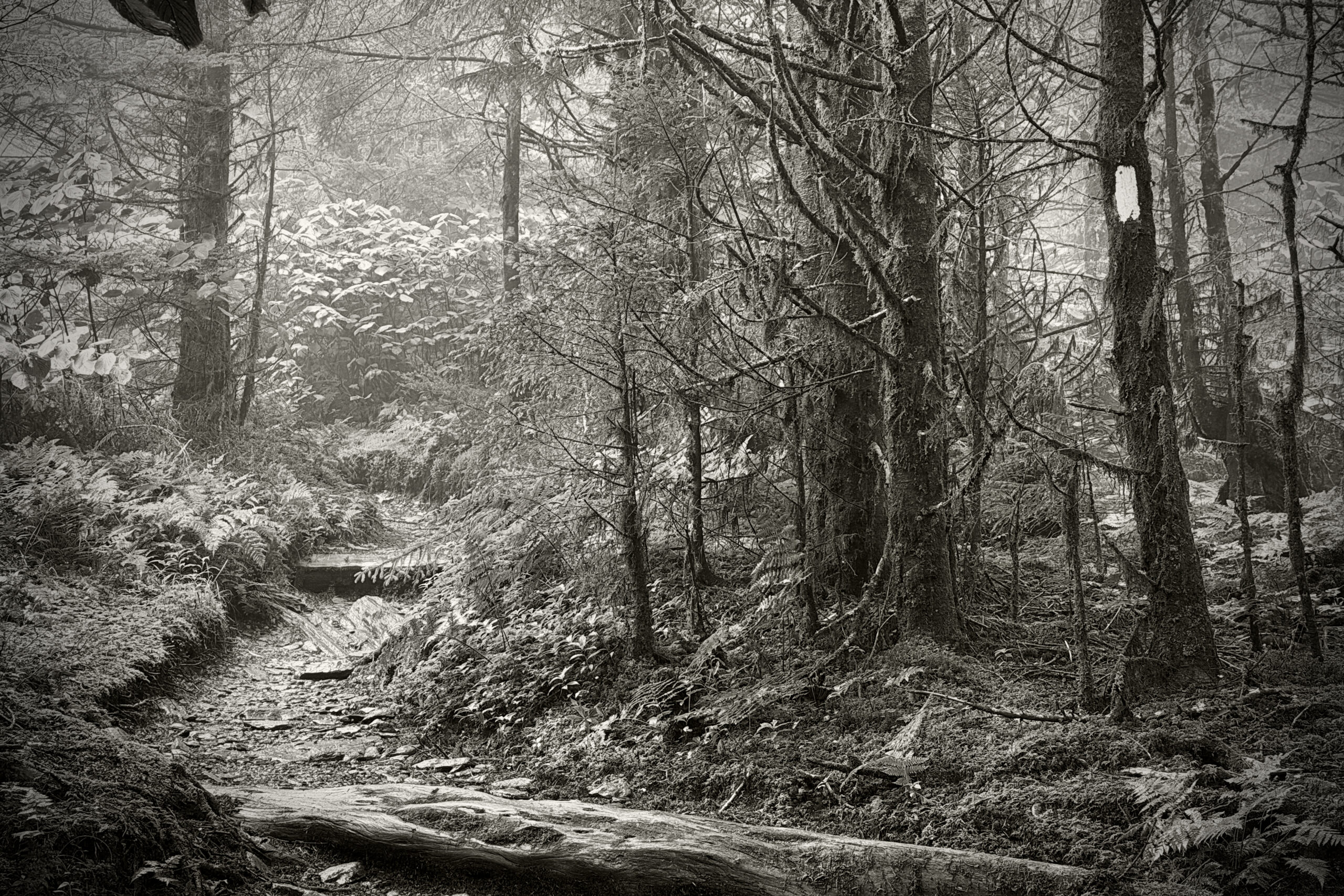
The Appalachian Trail runs nearly 2,200 miles, from Springer Mountain in Georgia to Mount Katahdin in Maine. Along its entire length — running north and south through national forests, state parks, and wilderness — white blazes are painted on trees beside the path, dispersed roughly one hundred yards apart. They are not landmarks. They are not destinations. They are simply marks — quiet, recurring confirmations that the hiker is still on the correct route. Unassuming. Reliable. Present whether or not the hiker is paying attention.
One section of the AT winds through Great Smoky Mountains National Park in Tennessee. It is, by most accounts, some of the most demanding terrain on the entire trail. I recently had occasion to embark on a section hike of the AT through the Smokies with some dear friends — beginning at the southern terminus on the NC/TN border and pressing north toward Clingmans Dome, the highest point in Tennessee, 72 miles ahead.
The trail does not ease you in. From the southern terminus, one must ascend several thousand feet of elevation to reach the first ridgeline in a span of roughly three miles. It is a slow, grinding climb. The whole time I kept thinking: once we make the ridgeline, it has to get easier. My pace slowed. The weight of the pack — real weight, the accumulated gear of several days in the backcountry — began to announce itself in ways it had not at the trailhead. Still, we were moving forward. And in the early miles of a long hike, that is the only thing that matters.
The trail sorted us the way long trails inevitably do. My pace had slowed, my hiking partners pressed ahead, and after one final switchback I found myself completely alone.
This was in no way alarming to me — I have become quite accustomed to solitude. But solitude on a trail has its own particular quality. The longer you go without a landmark, without a voice, without a point of reference, the more the thoughts begin to creep in. Where am I? What am I doing? Did I miss a trail junction?
The questions are not loud. They are insidious — small doubts that multiply in the silence, each one reasonable on its own, together capable of producing a kind of low-grade dread. This is the peculiar danger of the trail: not the dramatic hazard, but the accumulated uncertainty of simply not knowing whether you are still where you are supposed to be.
Just as I was beginning to grow genuinely concerned, I happened to look up.
A white blaze. On the tree to the right of the trail.
I was still on the right path.
That single confirmation — the quiet mark on the tree that said still here, still right — was enough. I exhaled. I reset my pace. The dread dissolved not because the trail had changed, but because I had been reminded of what I already knew: I had not wandered. The path was still beneath my feet. And that was sufficient.
At some point during a long hike, it becomes necessary to settle in — to regulate your breathing, your heart rate, and simply let the distance roll by. Fighting the trail is exhausting and ultimately futile. Accepting it — leaning into the rhythm of step after step after step, releasing the need to arrive before you have walked — is what allows the miles to pass and the mind to clear.
As I settled in and the climb continued, something that had been waiting at the edges of my awareness began to surface. It was not something I had planned to think about on the trail. It was something I had been carrying far longer than the pack on my back.
I began to think about forgiveness.
Not as a theological category. Not in the abstract, where it is always easier to handle. In the specific — the particular people, the particular wounds, the particular offenses that accumulate over years of living in close proximity to other broken human beings. The call of Christ to forgive as we have been forgiven is not a difficult command to understand. The logic is clear. The warrant is unambiguous. It is a difficult command to obey — and the longer I walked, the more convinced I became that the difficulty is not intellectual but volitional. We understand forgiveness well enough. We simply do not want to begin the climb.
Forgiveness, I realized, is a hike. And most of us are still standing at the trailhead.
You begin at sea level — aware of a wound, aware of the command, aware that the first steps are going to be the hardest. That first ascent is steep because forgiveness requires the surrender of something we have come to treasure without fully realizing it: the offense itself.
To hold an offense is to hold a kind of currency. In our fallen reasoning, it purchases a moral high ground over the one who wounded us — a sense that we are the wronged party, which is true, and therefore the superior party, which is not. We hold on with a conviction that feels like justice and functions like bondage. And the enemy understands this dynamic with great precision. He does not need us to sin dramatically. He only needs us to hold on — to keep adding stones to our packs as we sojourn through this life, each unresolved wound another weight that slows the pilgrim and bends the spine.
“Be kind to one another, tenderhearted, forgiving one another, as God in Christ forgave you.” (Ephesians 4:32, ESV)
Step by grueling step I ascended the ridgeline, and as my steps fell, I found myself working through past offenses — forgiving again, and again, wounds I had thought were long settled. The work was real. It was not a feeling. It was not a moment of inspiration on the mountaintop. It was deliberate, effortful, unglamorous — more like the slow repetition of steps on a switchback than anything resembling spiritual breakthrough. It cost something each time.
But as I walked, I became aware of something else. As I gazed up the trail to catch sight of the next white blaze, I realized that the Holy Spirit functions for us in much the same way — not loudly, not with fanfare, but with quiet, faithful regularity. He marks the path of obedience ahead of us. He ensures that the pilgrim who is paying attention is never truly lost. Not because the trail becomes easier, but because the guide does not leave.
“And I will ask the Father, and he will give you another Helper, to be with you forever.” (John 14:16, ESV)
The ascent did not become easy. But it became possible. And for the pilgrim mid-climb, possible is enough.
Days later, as we made our final ascent to Clingmans Dome, something had changed.
I found my rhythm. The miles seemed to melt away with a fluency that had been entirely absent at the start — not because the terrain was easier, but because I was no longer fighting it. My pack was lighter, not because anything had been removed from it, but because I had stopped fighting the weight. I felt more settled than I had in days, and I began to understand why.
The work of the first miles — the slow, unglamorous practice of forgiveness, offense by offense, surrender by surrender — had done something to me that I could not have manufactured at the trailhead. I felt lighter in ways that had nothing to do with my pack.
“And above all these put on love, which binds everything together in perfect harmony. And let the peace of Christ rule in your hearts.” (Colossians 3:14–15, ESV)
We cannot walk in that peace while carrying weight we were never meant to bear. But the trail teaches us, if we let it, that the pack does not have to be as heavy as we have made it — that what we have been holding with such conviction, such a sense of righteous entitlement, was never ours to carry. The climb does not end the wounds. But it does something more durable: it releases us from the obligation to carry them as though they define us.
And even still, just as at the beginning of the climb, I looked up and caught sight of a white blaze on the tree beside the trail — quietly, faithfully marking the way. Not celebrating my arrival. Not rewarding my effort. Simply present, as it had always been, confirming what I needed to know: I was still on the right path.
The Christian life is a long hike. Forgiveness is not a single act at the trailhead but a discipline of the trail — practiced step by step, surrender by surrender, through the steep sections and the long flat stretches where nothing seems to be happening and everything is. The Holy Spirit, our faithful Paraclete, does not leave us to navigate it alone. He marks the path. He reminds us of who we are and Whose we are. He walks with us through the places where the doubt creeps in, where the ridgeline seems impossibly far, where the pack feels heavier than we have the strength to carry.
The blaze is there. We are still on the right path. Keep walking.
From one man He made all the nations, that they should inhabit the whole earth; and He marked out their appointed times in history and the boundaries of their lands. God did this so that they would seek Him and perhaps reach out for Him and find Him, though He is not far from any one of us. Acts 17:26-27