
We are writing this from a camp in the northern Kenyan bush.
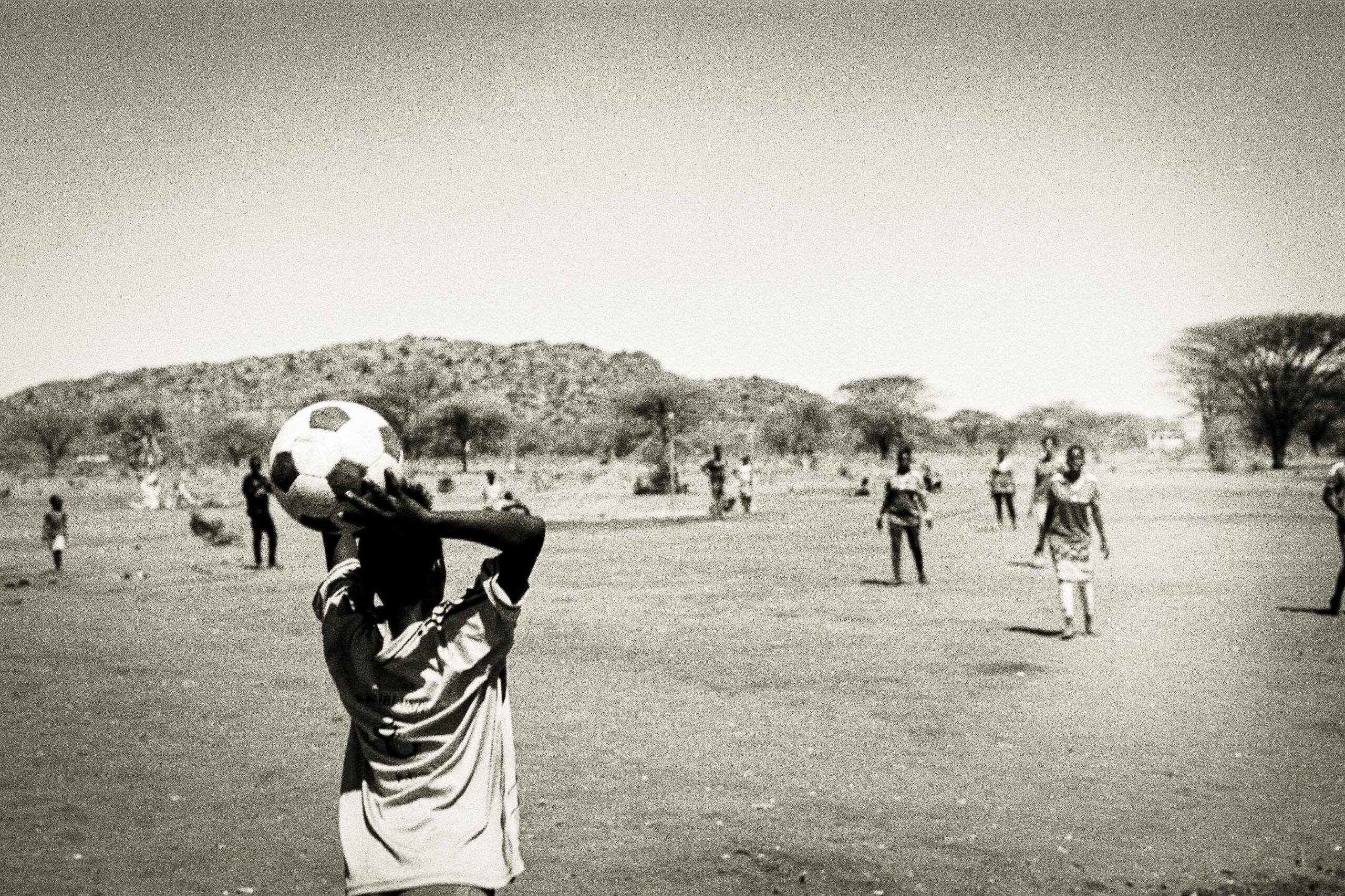
The tournament is underway. There are secondary students from villages across the Marsabit lowlands on a red-dust pitch just past the edge of camp — students who traveled hours to be here, most of them on roads that do not appear on any map that was not printed specifically for this region. The sound of the game drifts in intermittently: shouted names, the particular percussion of a football on dry ground, laughter.
The laughing carries.
Seven years ago, Peter LeKombe described this place differently.
When I asked Peter — who serves as a cross-cultural missionary mobilized by Beehive Global Collective to this region, who knows these roads and these people the way you know a road you have traveled in every season — to reflect on the current state of the work, he offered four observations. I am not going to paraphrase them.
“When we first arrived here, seven years ago, this place was in darkness — like an uncultivated scrub land. Now, after many faithful years, the seeds of the Gospel we have sown are germinating. Light is spreading from this place.”
“Our ministry team is dedicated and well organized, and that is making a real difference.”
“Our camp is a ‘laughing camp.’ There is much joy and brotherhood among us — even in the trials and difficult conditions.”
“Each member of our team is a servant first. We are here to give of ourselves — to be ‘poured out, as a drink offering,’ as the Apostle Paul would say.”
I have been in ministry long enough to receive many field reports. I have read summations that used more words and carried less weight. Peter’s four points are accurate, and they are enough.
But let me offer a few observations of my own — because the scrubland image deserves to be seen clearly.
A scrubland is not a wasteland. It is a land that has not yet been cultivated. The soil is there. The potential is there. What has not yet arrived is the patient labor of sowing — the long, unglamorous, often invisible work of breaking hard ground, scattering seed, and then doing the most difficult thing available to the farmer: waiting. Trusting that what has been placed in the ground is not lost. Trusting the One who makes things grow.
Seven years of that work has produced something. Peter named it plainly: germination. Light spreading.
This is the ministry of presence. This is what proximity discipleship produces in the long run — not dramatic overnight transformations, but the slow, deepening work of lives changed from the inside out, of communities that begin to carry the light they have received outward to the people around them. You cannot rush this. You can only show up, faithfully and repeatedly, and trust the Sower.
“He who sows and he who reaps may rejoice together.” (John 4:36, ESV)
We arrived at Nairibi early Saturday afternoon, after a grueling several days of travel.
The route from Nairobi north into the Marsabit interior is not a journey you take lightly. The A2 highway runs northward through Nanyuki, Archers Post, and Laisamis before the road gives way entirely — becoming, in the final stretch, a track through the bush that rewards slow, careful driving and punishes assumptions. The whole journey requires a full day at minimum, and this trip required a deliberate detour before we even began.
We stopped in Meru.
Meru sits on the northern slopes of Mount Kenya — a market town, a provisioning point, a place where you can still find what the deeper north cannot provide. We stopped there for one reason: to purchase a ministry motorbike.
This requires some explanation, because a motorbike is easy to misread as a convenience item. It is not. In the Marsabit interior, a motorbike is access.
Lebendera and L’Moti are reachable by the Camel — the Toyota Hilux that serves as our primary field vehicle — but the motorbike serves a different and equally important purpose. It is an onsite access point: a tool for the deepening work of returning, for the sustained, repeated cultivation of churches that are already growing. Peter will employ it primarily in Lebendera and M’Pargas — communities that need not an initial visit but a faithful rhythm of presence, the kind of returning that turns a planted church into a rooted one.
Beyond those communities, the motorbike will also carry Peter northward to Turkana, where our outreach among the El Molo people has been in need of reinvigoration.
There is a theology embedded in this: you cannot disciple from a distance. Proximity discipleship is not a methodology — it is a conviction. The shepherd must be near the sheep. The motorbike does not replace pastoral relationship. It enables it. It removes the practical obstacle that has been keeping the shepherd from the flock.
I am deeply grateful to everyone who gave toward its purchase.
Sunday morning, Rev. David and I had the honor of preaching together in Nairibi AGC.
We opened in Genesis 22.
The text is one of the most demanding in the Pentateuch — not because it is difficult to understand, but because it is impossible to read without cost. God calls to Abraham: “Abraham!” And Abraham answers with a single Hebrew word: hinneni. “Here I am.”
Three times Abraham says it in Genesis 22 — once to God (v. 1), once to Isaac (v. 7), and once to the Angel of the Lord (v. 11). The word is not a declaration of location. It is a declaration of availability. It means: I am fully present. I am at Your disposal. I withhold nothing.
The moment is staggering in its cost. Abraham does not know what God is about to ask. He answers before the question is fully formed. And the answer is — here I am. Whatever is required.
I pressed the congregation with the weight of it: when God calls — when He calls at the hard moment, the inconvenient moment, the moment you have been hoping would not come — what do you say? Do you say hinneni? Or do you say: not yet, not here, not this?
During the service, I received news that reframed everything around me. As a direct result of the Proximity Discipleship training held here in May, men who attended that seminar have been actively sharing the Gospel with renewed confidence — and there are new brothers in Christ in Nairibi.
This is the fruit of someone’s hinneni months earlier. Those men who came to the training in May — who answered the call to come, to learn, to be poured out and sent back — changed the communities around them. The seed was scattered in May. It is germinating now.
The Gospel does not require spectacle. It requires the faithful hinneni of ordinary people in ordinary places, willing to be present and available when God calls.
“For the word of God is living and active, sharper than any two-edged sword.” (Hebrews 4:12, ESV)
You do not know, when you scatter it, where it will land. You simply scatter it, trust the Sower, and watch.
Sunday afternoon, the tournament commenced.
Roughly three hundred and fifty secondary students have gathered here from villages across the northern lowlands — from Nairibi, Lorripa, Lontolio, and a delegation from L’Moti that we helped arrange travel for. They came for soccer. They are staying for something more.
Twice each day we are gathering the students for teaching sessions. The thesis is this: you were created on purpose, for a purpose.
In an environment where poverty is not abstract but immediate — where the questions of survival crowd out the questions of meaning — this claim cuts differently than it does in a comfortable setting. To tell a student from a bush village in northern Kenya that his life is not accidental, that the God of Abraham not only knows his name but assigned it significance before the foundations of the world — this is not sentiment. This is the most countercultural claim available.
We are tracing it through the story of Abraham.
Abraham is the hinge of the biblical narrative — the man through whom the fractured story of Genesis 1–11 is given its redemptive direction. He is a man who understands himself to be a sojourner — a ger — on this earth. Not as a lament, not as a complaint, but as a settled, clear-eyed identity. He knows where he is. He knows that it is not where he is ultimately going.
The writer of Hebrews puts it this way:
“For he was looking forward to the city that has foundations, whose designer and builder is God.”
— Hebrews 11:10 (ESV)
And later:
“These all died in faith, not having received the things promised, but having seen them and greeted them from afar, and having acknowledged that they were strangers and exiles on the earth.”
— Hebrews 11:13 (ESV)
Abraham saw the city from afar. He greeted it. He oriented his entire life — his tent-dwelling, his sojourning, his patient faithfulness in a land that was never permanently his — toward a destination he had not yet reached.
This is the identity God is offering these students.
Not a prosperity gospel. Not a promise that the red-dust road becomes a paved highway if they simply believe hard enough. But something more durable: a reorientation of the horizon. You are a sojourner. This world is not your final country. There is a city whose designer and builder is God — and the decisions you make today, on this pitch and in your village and in your family — are being made by a person who is on their way there.
That changes everything.
I want to return to Peter’s third observation, because it is the one that surprises people who have never been to this region.
Our camp is a laughing camp.
This is not easy terrain. The northern Kenyan bush is arid, remote, logistically demanding, and not designed for comfort. The roads in are long and hard. The roads out are the same. Water is precious. Power is variable. The work is demanding and the hours are long.
And the camp is full of laughter.
This is not the laughter of people who have avoided difficulty. It is the laughter of people who have walked into difficulty together and found, on the other side of the hard part, that they are still standing — and still glad to be here. It is the laughter that Nehemiah had in mind when he wrote that “the joy of the Lord is your strength” (Nehemiah 8:10, ESV) — not joy as the absence of hardship, but joy as the presence of the One who makes hardship survivable.
Peter has been in this place for seven years. He has watched scrubland become something else. He has scattered seed in ground that did not always look promising. He has stayed when staying was not comfortable. And he leads a team that laughs.
That is not a minor observation. That is the testimony of a community shaped by the Gospel — a community that knows where it is going, that takes its work seriously without taking itself too seriously, that finds brotherhood in the trials and difficulty instead of resentment.
The Apostle Paul wrote from a prison cell: “I have learned, in whatever situation I am, to be content.” (Philippians 4:11, ESV) And elsewhere, anticipating the possibility of his death as an act of faithful ministry: “Even if I am to be poured out as a drink offering upon the sacrificial offering of your faith, I am glad and rejoice with you all.” (Philippians 2:17, ESV)
Poured out. Glad. Rejoicing.
This is the camp Peter described. This is the ministry of the northern bush.
I am writing this from that camp, with the sound of the tournament in the background and the work of the day ahead.
Seven years ago, Peter LeKombe described this place as an uncultivated scrub land. He was not being disparaging. He was naming it accurately — naming the soil for what it was, before the sowing began.
The sowing has been happening for seven years.
The seeds are germinating.
Light is spreading from this place.
That is not my assessment. It is Peter’s — the man who has been here, who has done the long, unglamorous, faithful work of presence, who has stayed when staying was not easy and laughed when laughter was the most honest response available.
I am grateful to be here. I am grateful for everyone who made it possible — who gave, who prayed, who trusted that the work in this remote corner of northern Kenya is worth sustaining.
The city is still ahead. The sojourner is still moving. And the seeds, faithfully scattered, are doing what seeds do when the Sower is good.
Soli Deo Gloria.
Mathew
Beehive Global Collective
From one man He made all the nations, that they should inhabit the whole earth; and He marked out their appointed times in history and the boundaries of their lands. God did this so that they would seek Him and perhaps reach out for Him and find Him, though He is not far from any one of us. Acts 17:26-27