
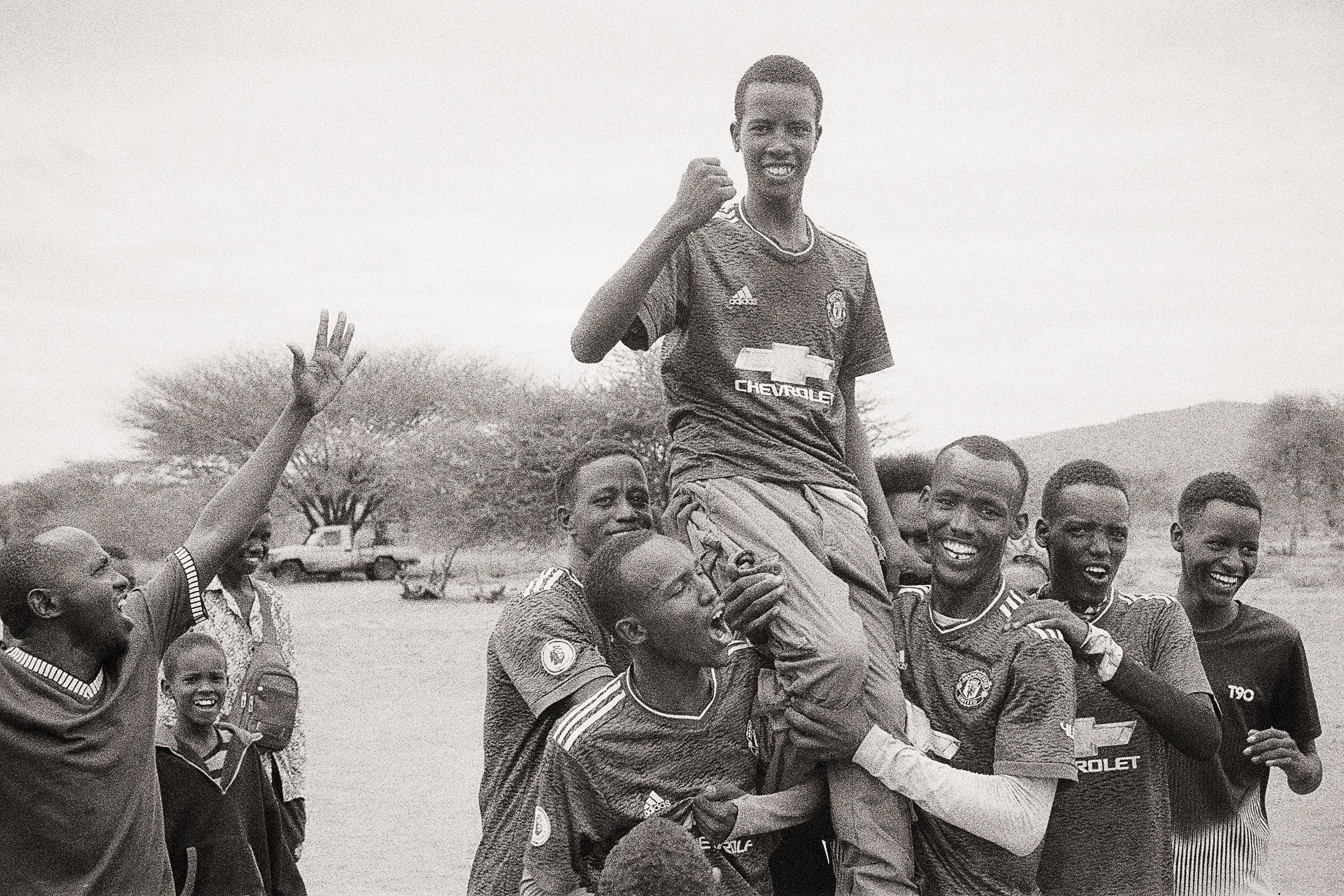
The tournament is over.
For five days, three hundred and fifty secondary students from across the northern Kenyan lowlands gathered on a red-dust pitch at the edge of our camp — from Nairibi, Lorripa, Lontolio, and L’Moti — to play football, to eat together, and twice each day, to sit and hear the Word of God. They came for the competition. We came for the harvest. And on the final afternoon, God closed what He had opened at the beginning of the week in a way that none of us will carry lightly from this place.
This is the account of that final day.
There is a passage in Joshua that can deceive you with its familiarity.
The scene appears in Joshua 24, and it is, on the surface, structurally unremarkable for the period. The people of Israel are gathered — elders, heads, judges, officers — and a leader speaks the Word of the Lord to them. We have seen this before. Moses at Sinai. Moses on the plains of Moab. Aaron in the wilderness. The pattern is so repeated across the narrative books that the mind settles into recognition: someone is gathering Israel to hear from God.
But before we allow that recognition to become inattention, we must look carefully at what makes Joshua 24 singular.
When the Lord speaks at Shechem, He does not issue a command. He does not begin with law, with warning, with instruction. He begins with history — His own. From Abraham in Ur, through Isaac and Jacob, through Egypt and the Exodus, through the wilderness and the Jordan and the conquest of Canaan — the Lord stands before His people and gives an accounting of His own faithfulness.
“Thus says the LORD, the God of Israel, ‘Long ago, your fathers lived beyond the Euphrates, Terah, the father of Abraham and of Nahor; and they served other gods. Then I took your father Abraham from beyond the River and led him through all the land of Canaan, and made his offspring many.'”
— Joshua 24:2–3 (ESV)
Twenty-seven verses of this. The Lord reaching back to Genesis 12 and pressing forward through every generation — naming what He did, what He promised, what He provided. It is not a defense. It is not an apology. It is a declaration. Here is who I am. Here is what I have done. Here is the record — all of it — laid before you in full light.
And it is precisely this recital that frames what Joshua says next.
Joshua has watched the whole arc of that history. He has stood at the bank of the Jordan. He has buried Moses’ generation in the wilderness. He is the oldest man in the assembly at Shechem, and when the Lord finishes His accounting, Joshua plants a flag — not in the ground, but in the present tense.
“Now therefore fear the LORD and serve Him in sincerity and in faithfulness. Put away the gods that your fathers served beyond the River and in Egypt, and serve the LORD. And if it is evil in you to serve the LORD, choose this day whom you will serve, whether the gods your fathers served in the region beyond the River, or the gods of the Amorites in whose land you dwell. But as for me and my house, we will serve the LORD.”
— Joshua 24:14–15 (ESV)
The phrase in verse 15 that carries the full weight of Joshua’s declaration is not the famous one at the end. It is the one in the middle: choose this day.
The sojourner’s life — the pilgrim path we traced together all week through the Genesis narrative — is not a state you arrive into and hold passively. It is a posture you choose. And you choose it again at every crossroads.
But note what makes Joshua’s summons possible. He does not call Israel to choose on the basis of moral obligation alone. He calls them to choose on the basis of demonstrated faithfulness. God has kept every promise He has made. The whole account the Lord just recited — from Ur to Shechem — is the ground of the summons. The invitation to choose is not issued into a vacuum. It is issued over a record.
Choose. Because He is a promise-keeping God. Choose. Because the road He has led you on is not finished. Choose. As for me and my house — we will serve the LORD.
Here is the detail that brought the entire week into focus as I prepared to deliver this message.
When we last stood in Shechem together — in Genesis 35, in the middle of the week — Jacob was fleeing from it. His sons had committed a massacre. The land was hostile. He was, again, reading the room for the exit. It was the third flight in the three-act narrative of a man who kept running from the weight of a name he had already been given.
We returned to Shechem to close the tournament.
Not as coincidence. As architecture.
The same geography, centuries apart, carrying the same question: What will you do with what God has shown you? What Jacob could not yet answer from within his running — what the people of Israel had been learning to answer across forty years of wilderness and conquest — Joshua now puts plainly before an entire generation at Shechem. And I had the privilege, on the final afternoon of this week, of putting it plainly before three hundred and fifty students from the northern Kenyan bush.
We traced back through everything together — the same way the Lord traces back through Israel’s history before Joshua speaks.
Abram in Genesis 12, called out of Ur with a word and no map. A choice to go.
Lot in Genesis 13, lifting his eyes toward what was pleasing and choosing toward it. A choice for the near.
Abraham in Genesis 22, answering hinneni before God had finished forming the question. A choice of full availability.
Jacob at Bethel, at Peniel, at Shechem — running and returning, being met by the same faithful God at every point of the road. A God who did not wait for Jacob to become Israel before He treated him as one.
Every lesson we had taught this week was a chapter in the same account the Lord recites in Joshua 24. This is who I am. This is what I have done. This is what I have kept. And now, as the week closes, as these students prepare to return to their villages and their boarding schools and the ordinary roads of their lives — the question is the same one Joshua raised at Shechem:
Choose this day. Who will you serve?
I was not prepared for what happened next.
As the message closed, a silence fell over the crowd.
The entire week, there had been the particular ambient energy of a gathering of three hundred and fifty secondary students — movement, laughter, the low hum of translation at the edges of every teaching session, the sound of camp life carrying on around us. Even in the most attentive moments, the crowd breathed and shifted and lived.
This was different.
No one was moving. No one was stirring. The young boys in the front row — who had been the first to arrive at every session and the last to sit still — were motionless. And in the trees above the teaching area, where the hornbills and starlings have trilled and called throughout the entire week, there was quiet. A pause in the ordinary music of the northern bush. A moment of unnatural stillness that settled over the camp like a held breath.
I have been in ministry long enough to know the difference between silence that is empty and silence that is full.
This was full.
Something was happening in it that was not produced by the message or the setting or the accumulated weight of a week of teaching. The One who stills storms was present in the still.
When the silence broke, it broke with movement.
Many moved forward to accept Christ for the first time — students who had come to this tournament for a football match and were leaving with something they had not brought with them. Others pledged, in their own words and in their own way, to choose this day to return to the sojourner’s life — to live with the eternal in mind, to point others to Jesus, to carry the pilgrim identity not as a theological category but as a daily orientation.
Joshua’s summons had landed.
The series had asked, in many different ways over the days of teaching, a single question: What does it look like to live now as though eternity is real? The answer was never a program. It was always a person. A God who is real, who calls, who renames, who is recognizable in Scripture and in the road and in the camp and in the silence. And who, at every Shechem in every generation, asks the same thing:
Choose this day.
They chose.
The students from Lontolio and L’Moti have returned home. In the coming days, they will travel to boarding schools across the northern region — small schools in remote districts, most of them hours from the nearest town. They will carry with them whatever this week deposited.
Our prayer is this: that they go forward choosing this day, and the next day, and the day after, to serve the LORD. That the Shechem moment does not fade the way tournament memories fade — with the dust of the journey home. That the God who met them in the silence remains near to them as they re-enter the ordinary, and that the choice they made or renewed at the close of this week becomes the posture of their lives.
The tournament is over. The work is not.
We are grateful — deeply and genuinely — for every prayer and every gift that made this week possible. You were not here, but your faithfulness was. The seeds scattered in the northern bush this week were planted, in part, by your generosity. That is not a courtesy. That is the truth of how the body of Christ works:
“Neither he who plants nor he who waters is anything, but only God who gives the growth.”
— 1 Corinthians 3:7 (ESV)
We planted together. We watered together. God gave the growth.
Choose this day. Who will you serve?
Soli Deo Gloria.
Mathew
Beehive Global Collective
From one man He made all the nations, that they should inhabit the whole earth; and He marked out their appointed times in history and the boundaries of their lands. God did this so that they would seek Him and perhaps reach out for Him and find Him, though He is not far from any one of us. Acts 17:26-27