
There is a verse in Proverbs that I have returned to often over the course of this week.
“Iron sharpens iron, and one man sharpens another.” (Proverbs 27:17, ESV)
It is a short verse. It does not elaborate. It does not explain the mechanism by which the sharpening occurs, or specify how long the process takes, or offer a consolation for the friction it requires. It simply states, as a fact of the created order, that something happens when iron meets iron — and that the same thing happens when one believer draws near to another.
Two conversations this week have given me a fresh understanding of what that sharpening looks like in practice. I want to tell you about both of them, because together they illuminate something I have come to believe is one of the most important and least-discussed dimensions of proximity discipleship: it flows both ways.
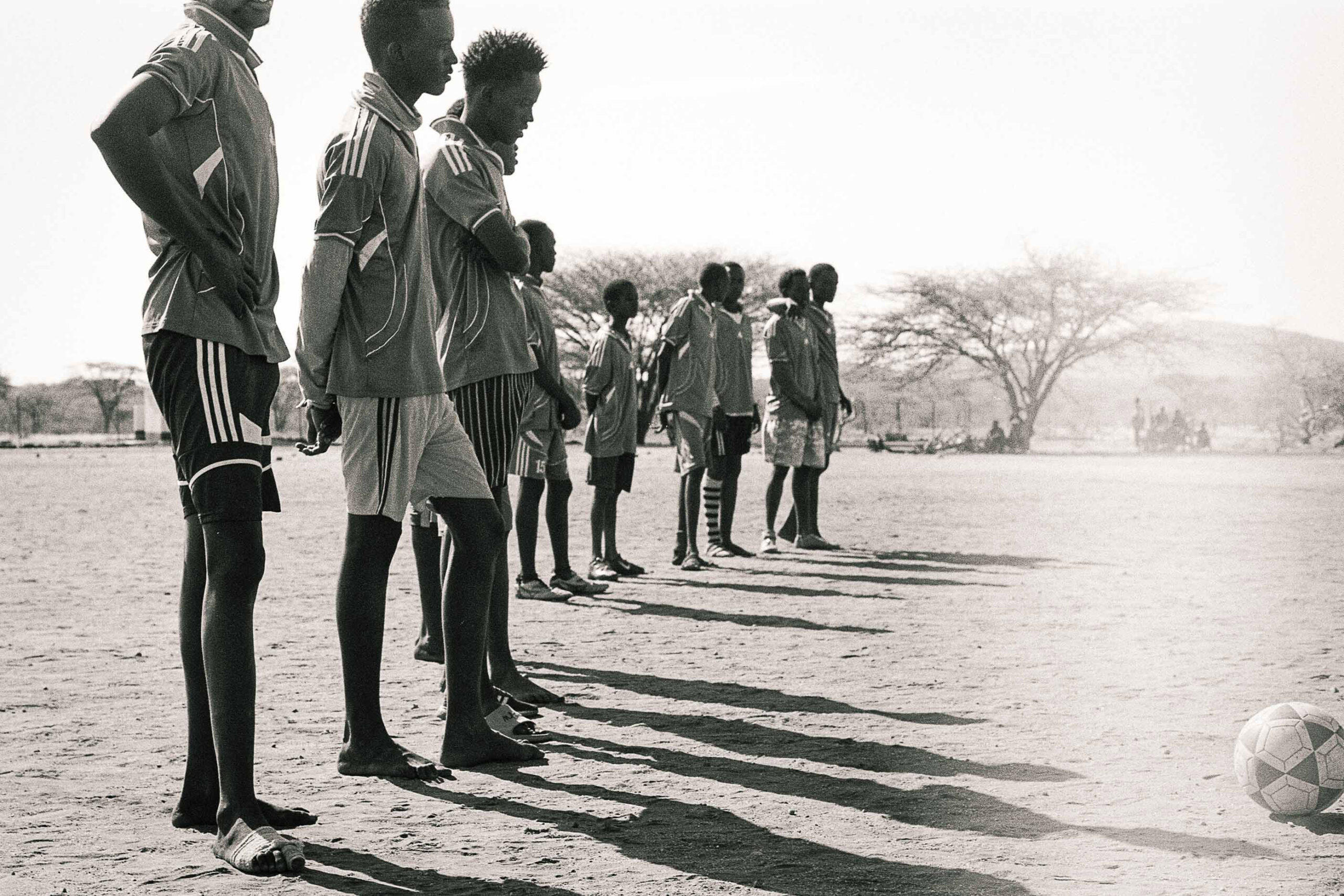
The Youth Leadership Committee had gathered that evening to go over the final details for the tournament. It was a working meeting — logistics, assignments, timing — and the camp was busy with the particular energy of a team moving toward a significant event.
But in the margins of the meeting, I found myself in conversation with Ben.
I have known Ben for several years. I have visited his manyatta — the traditional homestead where he and his wife have built their life and their ministry — and I have watched, from a distance and then up close, as the two of them have developed an outreach to young village children near Lorripa. It is quiet work. It does not generate headlines. But it is exactly the kind of work that proximity discipleship produces in people who have genuinely absorbed it: they begin to do it themselves, with whoever is nearest to them.
As Ben described what they are currently doing — engaging children at the earliest possible age, building into them a deep and personal connection to who God is before the world has had time to form competing loyalties — I recognized the vocabulary. It was the vocabulary of someone who has internalized a conviction, not merely adopted a program. He was not describing an outreach event. He was describing a way of life.
What he said next, however, is what I will carry longest from this week.
He began to reflect on Sunday’s sermon — the Genesis 22 passage on hinneni, on Abraham’s full and costly availability before God. And he named something I had not named in the pulpit. He noted that when Isaac calls out to his father mid-climb — “My father” — and Abraham answers, “Here I am, my son” (Genesis 22:7, ESV), the next question Isaac asks is the one that has haunted readers of this text for millennia: “Behold, the fire and the wood, but where is the lamb for a burnt offering?” (Genesis 22:7, ESV)
And Abraham — who knows what God has asked, who is carrying the weight of the most demanding command in the Pentateuch — turns to his son. His only son. The son he loves. And he does not deflect. He does not change the subject. He does not offer a vague reassurance. He points Isaac back to God.
“God will provide for Himself the lamb for a burnt offering, my son.” (Genesis 22:8, ESV)
It is, as Ben noted, a simple moment. But it is a profound detail. In the most costly moment of Abraham’s obedience, his pastoral instinct — the instinct of a father, the instinct of a disciple — is to orient his son toward the One who provides. The climb continues. The answer is not full. But the direction is clear: look to God.
I had preached that text. I had studied it. I had not seen that.
I am grateful for the lesson. And I am grateful for Ben.
The second conversation was different in character — quieter, less structured, arriving without announcement in one of those rare openings the field occasionally provides.
The day had ended. The camp had found its rhythm in the closing hours — various members of the team occupied with the particular tasks that bring a long day in the northern bush to its close. And Rev. David and I found ourselves, briefly, alone.
These moments are not something you can manufacture. They arrive when the schedule opens unexpectedly and two people who have spent years in proximity to one another finally have the margin to say what ordinarily goes unsaid. We began where we often begin — with the work, with the students, with the question of how to better engage the teaching sessions still ahead.
But the conversation turned.
I do not remember the precise moment of transition. What I know is that we found ourselves somewhere else — somewhere older. We were talking about the early years. The years when the path forward was not clear, when the budgets were lean and the support was thin, when the weight of what we had committed ourselves to seemed, in certain moments, to exceed what we were capable of carrying. There were seasons, we admitted to one another with the honesty that only long friendship permits, when we were both tempted to set it down. To find other vocations. To quietly release the call and choose something easier.
Neither of us did.
And sitting there in the closing light of a Wednesday evening in the Marsabit bush, reminding one another of the faithfulness of God in those early seasons — naming what He had done, specifically and concretely, in the moments when the way forward had seemed completely occluded — was, as I can only describe it, a balm to my soul.
“And let us consider how to stir up one another to love and good works.” (Hebrews 10:24, ESV)
This is what that verse looks like when it is practiced. Not a program. Not a curriculum. Two men at the end of a long day, in a camp in the northern Kenyan bush, reminding one another of who God has been — and, by extension, of who He will continue to be.
Here is what I have been turning over since both conversations.
Proximity Discipleship is not a one-directional flow. We sometimes speak of it as if the disciple-maker is the one doing the giving — drawing near, pouring out, offering what they have — and the one being discipled is the one receiving. That framing is not wrong, as far as it goes.
But it does not go far enough.
When Ben taught me something I had missed in a text I had studied and preached, the grace of God was not flowing from me to him. It was flowing from him to me. When Rev. David and I sat together at the end of a long day and named the faithfulness of God in the hard seasons of our early ministries, we were sharpening one another equally. Iron meeting iron. Neither of us the whetstone. Both of us being shaped.
This is the deeper logic of Proverbs 27:17. The sharpening does not require one piece of iron to be harder than the other. It requires contact. It requires proximity. The friction is the point.
As we draw near to one another in faith — near enough to have the real conversation, long enough for the unsaid things to finally surface — God’s grace moves through the contact. It flows out of us and into the ones beside us. And it flows back.
This is why we come to Marsabit. Not merely to teach, not merely to serve, but to be present — to enter into the friction and the fellowship of proximity, trusting that the Sharpener knows what He is doing with the iron He has placed in the same field.
The tournament is drawing to a close.
By the time this post reaches you, the final regular-play matches will have been completed. Three hundred and fifty students from across the Marsabit lowlands — from Nairibi, Lorripa, Lontolio, and L’Moti — will have played out their group stages, and only the Final Match remains. It will happen on Friday. It will draw spectators from the surrounding villages. It will be, by any measure, the largest gathering of the week.
And at its close, we will feed everyone present.
The community meal is not an afterthought. It is not a logistical appendage to the tournament. It is a culminating act of service — a gesture of hospitality extended outward from the camp to the whole community: from the 350 students who traveled here to the neighbors, parents, and village elders who will come to watch. To set a table in the northern desert for whoever arrives is to enact, in a small but tangible way, the posture of the Kingdom.
We continue, twice each day, to gather the students for teaching. The message has been consistent throughout: if you choose to walk this pilgrim path — to take up the identity of the sojourner who lives in a world that is not yet his final country — you will not walk it alone.
“It is the LORD who goes before you. He will be with you; He will not leave you or forsake you. Do not fear or be dismayed.” (Deuteronomy 31:8, ESV)
We are pressing that promise into every student who will receive it.
We are grateful — deeply and genuinely — for your continued prayer and partnership. We are in the last furlong of this event. The Final Match is ahead. The meal is prepared. The students have heard the Word.
Please pray for protection and safety as the week closes. Pray that the hearts of these students remain open — that the voice of Jesus, calling them onto the pilgrim path, will be heard above every competing voice.
The God who provided the lamb for Abraham is the same God who is present in this camp tonight.
Soli Deo Gloria.
Mathew
Beehive Global Collective
From one man He made all the nations, that they should inhabit the whole earth; and He marked out their appointed times in history and the boundaries of their lands. God did this so that they would seek Him and perhaps reach out for Him and find Him, though He is not far from any one of us. Acts 17:26-27